MEDIA STATEMENT
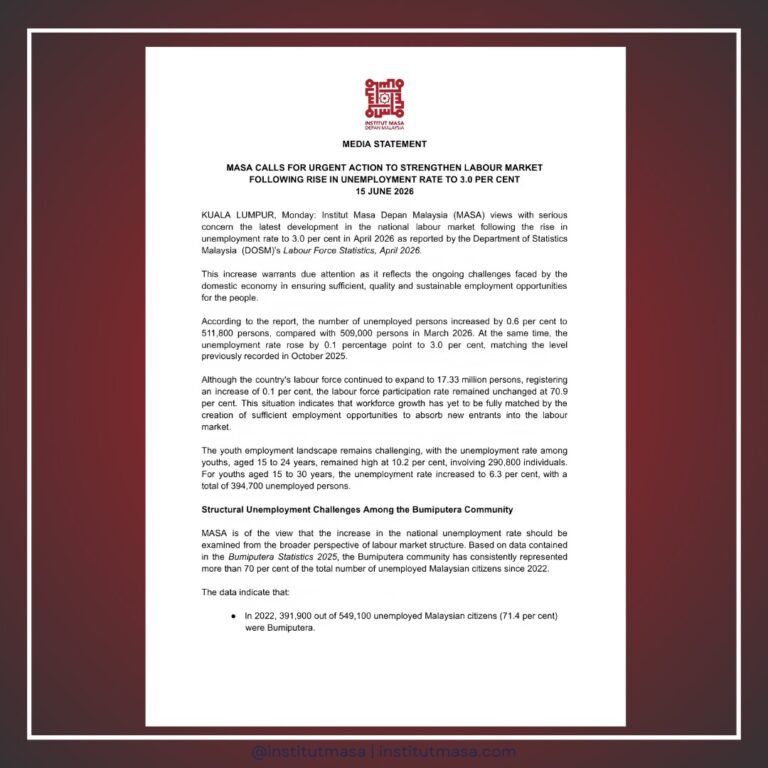
MASA CALLS FOR URGENT ACTION TO STRENGTHEN LABOUR MARKET FOLLOWING RISE IN UNEMPLOYMENT RATE TO 3.0 PER CENT
15 JUNE 2026
KUALA LUMPUR, Monday: Institut Masa Depan Malaysia (MASA) views with serious concern the latest development in the national labour market following the rise in unemployment rate to 3.0 per cent in April 2026 as reported by the Department of Statistics Malaysia (DOSM)’s Labour Force Statistics, April 2026.
This increase warrants due attention as it reflects the ongoing challenges faced by the domestic economy in ensuring sufficient, quality and sustainable employment opportunities for the people.
According to the report, the number of unemployed persons increased by 0.6 per cent to 511,800 persons, compared with 509,000 persons in March 2026. At the same time, the unemployment rate rose by 0.1 percentage point to 3.0 per cent, matching the level previously recorded in October 2025.
Although the country’s labour force continued to expand to 17.33 million persons, registering an increase of 0.1 per cent, the labour force participation rate remained unchanged at 70.9 per cent. This situation indicates that workforce growth has yet to be fully matched by the creation of sufficient employment opportunities to absorb new entrants into the labour market.
The youth employment landscape remains challenging, with the unemployment rate among youths, aged 15 to 24 years, remained high at 10.2 per cent, involving 290,800 individuals. For youths aged 15 to 30 years, the unemployment rate increased to 6.3 per cent, with a total of 394,700 unemployed persons.
Structural Unemployment Challenges Among the Bumiputera Community
MASA is of the view that the increase in the national unemployment rate should be examined from the broader perspective of labour market structure. Based on data contained in the Bumiputera Statistics 2025, the Bumiputera community has consistently represented more than 70 per cent of the total number of unemployed Malaysian citizens since 2022.
The data indicate that:
- In 2022, 391,900 out of 549,100 unemployed Malaysian citizens (71.4 per cent) were Bumiputera.
- In 2023, the figure stood at 354,900 out of 483,700 unemployed Malaysian citizens (73.4 per cent).
- In 2024, 336,300 out of 463,900 unemployed Malaysian citizens (72.5 per cent) were Bumiputera.
Based on this pattern, the increase in the number of unemployed persons to 511,800 in April 2026 has the potential to disproportionately affect the Bumiputera community should these structural trends persist.
These challenges are not solely related to the availability of employment opportunities but also involved issues such as skills mismatch, job mismatch, dependence on low-productivity sectors and high participation in informal employment and the gig economy.
Therefore, efforts to strengthen workforce competitiveness and enhance graduate employability must become key priorities in empowering the nation’s labour market.
Policy Recommendations and Intervention Measures
To ensure that Malaysia’s labour market remains resilient and inclusive, MASA recommends that the government consider the following strategic measures:
- Establishment of a Labour Market Empowerment Task Force
The government is encouraged to establish a special cross-ministerial task force involving the Ministry of Economy, Ministry of Human Resources, and Ministry of Finance, to coordinate labour market interventions in a more integrated and data-driven manner. - Strengthening Employment Incentives and Employer Support
The government may consider expanding employment incentives and providing targeted support to small and medium enterprises (SMEs) to encourage the creation of new job opportunities, particularly for youths and the long-term unemployed. - Industry-Based Reskilling and Upskilling Programmes
Reskilling and upskilling initiatives should be enhanced through strategic collaboration between the government, training institutions and industry players to meet the demands of high-growth sectors such as digital technology, artificial intelligence (AI), automation, data analytics and green economy. - Greater Involvement of GLCs and GLICs in Talent Development
Government-Linked Companies (GLCs) and Government-Linked Investment Companies (GLICs) are encouraged to play a more active role in providing industrial training opportunities, talent development programmes and the recruitment of fresh graduates to accelerate workforce absorption into the formal economy.
Unemployment is not merely a statistical indicator – it reflects the realities of people’s lives, the well-being of households and the nation’s capacity to create inclusive and quality opportunities.
In this regard, all stakeholders, including the government, industry, educational institutions and economic players, must strengthen strategic collaboration to ensure that Malaysia’s labour market remains resilient, responsive to global economic changes and is capable of providing more sustainable future prospects for all Malaysians.
AZRIL MOHD AMIN
Chief Executive Officer
Institut Masa Depan Malaysia (MASA)